
IELTS (5,031) & TOEFL (6,970) Vocabulary Preview
Sitting down for an IELTS practice test after preparing for TOEFL—or vice versa—immediately reveals how differently the two exams test vocabulary. IELTS cares deeply about exact spelling on listening form-completion blanks and natural verb-noun collocations in essays about city traffic, farming, or public spending. TOEFL iBT drops us straight into a five-minute university lecture on bird migration, island species, and fossil layers, holding back the questions until the audio finishes.
When I used to prepare with plain front-and-back flashcards, I often felt confident while flipping through the deck, only to miss a word when two syllables linked together in fast lecture audio or drop a double consonant on a listening blank. Recognizing a word with our eyes is only half the job; our ears and fingers need to know it just as well.
On the Mocavoca bookshelf, we prepared two full exam wordbooks—IELTS Vocabulary (5,031 words) and TOEFL Vocabulary (6,970 words), organized from open ECDICT exam tags—alongside our compact 953-word Academic Word List (NAWL). Every 4-word group walks through three checks: meaning selection (meaning), blind audio recognition without text on screen (listening), and full keyboard typing (spelling).
Four cards from the IELTS & TOEFL wordbooks
We pulled four cards from Mocavoca’s built-in ielts-exam and toefl-exam wordbooks—commute, curb, migrate, and species—to trace how civic essay topics and natural science lectures use these words in context.

commute
/kəˈmjut/ · v. to travel regularly between home and work
Many people commute between their suburban homes and downtown offices daily.
很多人每天往返于郊区的家和市中心的办公室之间通勤。
Whether an examiner asks about daily routines in IELTS Speaking Part 1 or we are writing a Task 2 essay on urban transit, the verb commute captures the back-and-forth journey between home and work in a single word. Reading the example sentence, we can also pick up the natural contrast pair suburban homes and downtown offices—and remember the double m for listening fill-in-the-blank questions.

curb
/ˈkɝb/ · v. to keep something under control or limit its growth
We should curb spending until the new year.
我们应该抑制开支,直到新年。
Moving from city traffic to public policy essays, we often want to talk about reining in carbon emissions, rising prices, or government spending. Writing stop sounds too absolute—no policy wipes out pollution or spending overnight. Like pulling back on a horse’s reins, curb means keeping a rising trend under control. Once curb spending feels natural, phrases like curb pollution and curb traffic congestion come easily on exam day.

migrate
/ˈmaɪˌɡreɪt/ · v. to move from one place or region to another
These birds migrate south before the winter arrives.
这些鸟在冬天到来前会向南迁徙。
Stepping into a TOEFL biology lecture, the topic often opens with seasonal animal movement. Notice how the direction adverb south follows migrate directly without the preposition to (migrate south). When practicing this card, it helps to say its noun form (migration) and adjective form (migratory birds) aloud together so we never lose the thread when the professor switches parts of speech mid-lecture.

species
/ˈspiʃiz/ · n. a group of animals or plants that can breed together
This bird species lives only on that island.
这种鸟只生活在那座岛上。
Following those migrating birds to an isolated island brings us to species—a classic grammar trap in integrated writing. Look at the subject-verb agreement in the sentence: This bird species lives... Even though species ends with an -s, its singular and plural spellings are identical. Pairing singular This with singular lives (and many species with live) keeps our writing clean.
Planning a five-thousand-word list
Staring at 5,031 IELTS words or 6,970 TOEFL words from page one is intimidating. If we treated every entry as an unseen word, studying 8 new words a day would take 629 to 872 study days (counting first-pass days before reviews).
In reality, anyone preparing for IELTS or TOEFL already knows half or more of the general foundation words inside these lists. As we flip through cards in Mocavoca, tapping “Mark as familiar” on words we already know skips today’s drills and schedules a quick verification check in 3 days—leaving our daily 8 to 12 new-word quota for genuine exam gaps.
| Wordbook & study stage | Remaining words to learn | Study days at 8 new words / day | Study days at 12 new words / day |
|---|---|---|---|
| Step 1: Academic Word List (NAWL) | 953 words | 120 study days | 80 study days |
| IELTS 5,031 (after marking ~3,500 known words familiar) | ~1,531 words | 192 study days | 128 study days |
| TOEFL 6,970 (after marking ~4,500 known words familiar) | ~2,470 words | 309 study days | 206 study days |
| Full-list baseline (IELTS 5,031 / TOEFL 6,970 from zero) | 5,031 / 6,970 words | 629 / 872 study days | 420 / 581 study days |
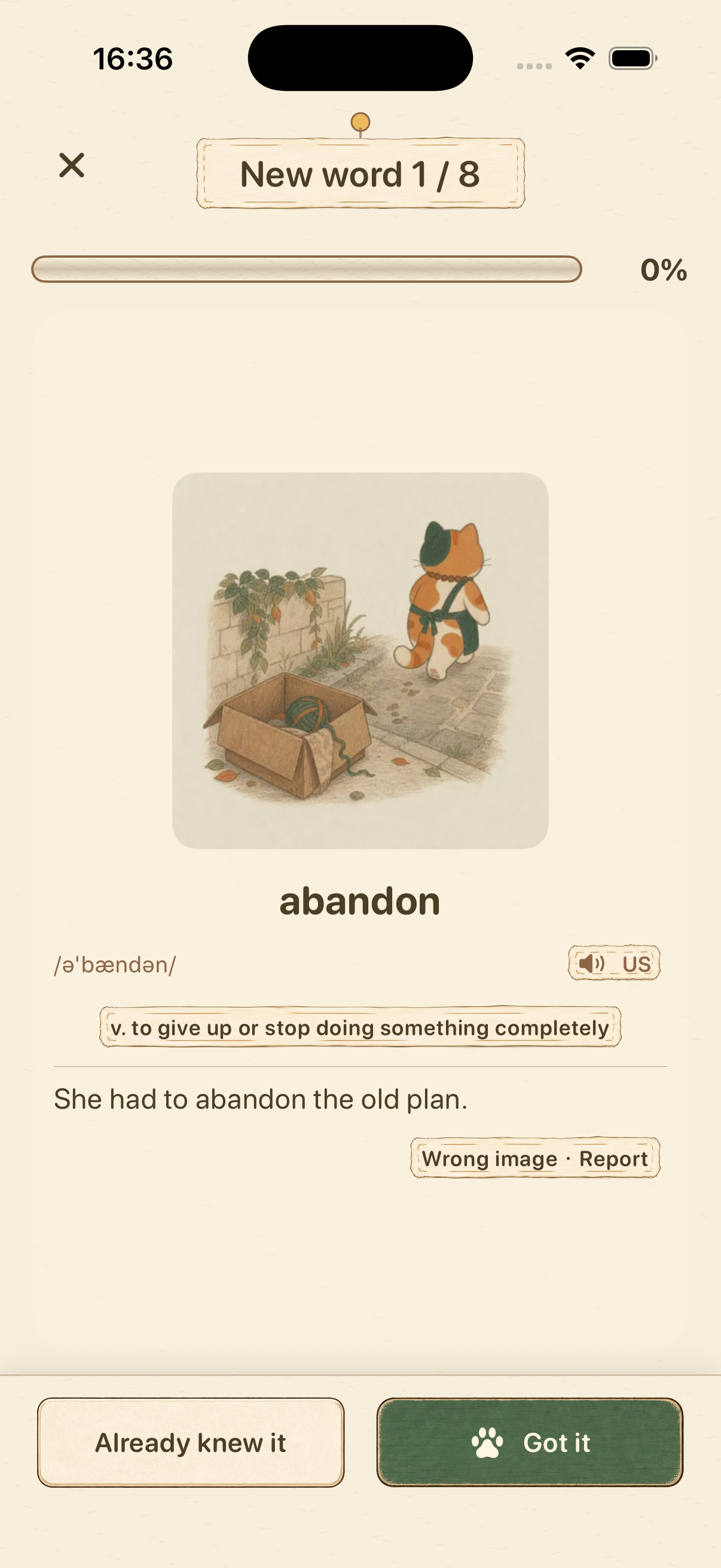
Open the IELTS & TOEFL Wordbooks
Study with one-screen watercolor cards, blind listening and full spelling checks, and a 1–3–7–14–30 day spaced repetition calendar. Switch freely between NAWL, IELTS, and TOEFL with independent progress saved per book.

Frequently asked questions
Should I start with the 953-word Academic Word List (NAWL) or jump straight into the IELTS / TOEFL wordbook?
If our test date is less than three months away, starting with the 953-word NAWL wordbook is the most manageable way to cover cross-disciplinary academic vocabulary in one round. With four or more months available, we can open the full IELTS or TOEFL deck and mark known foundation words as familiar as we go.
How does Mocavoca help with IELTS Listening spelling and TOEFL lecture audio?
Every 4-word group includes a blind audio prompt (listening, where we identify the word by sound alone without seeing text) and a full keyboard typing check (spelling). Any slip or hint triggers an interleaved retry after at least 2 other cards and resets the word’s review interval to tomorrow (+1 day).
Source attribution
Source: ECDICT (MIT License), filtered by IELTS and TOEFL exam tags.
Academic Word List (NAWL 953 words) · JLPT N5 Japanese Selection · 1–3–7–14–30 Spaced Repetition Schedule · How to Choose a Vocabulary App · Calculate Your Daily Pace · Download & Subscription Details