
Getting started and choosing a wordbook
Mocavoca combines illustrated watercolor flashcards, three-way active recall, and a 1 → 3 → 7 → 14 → 30-day spaced repetition schedule inside a quiet cat café. On your first launch, choosing a wordbook and a daily new-word pace takes less than a minute—after that, Today’s Plan automatically queues your due reviews and daily new words.
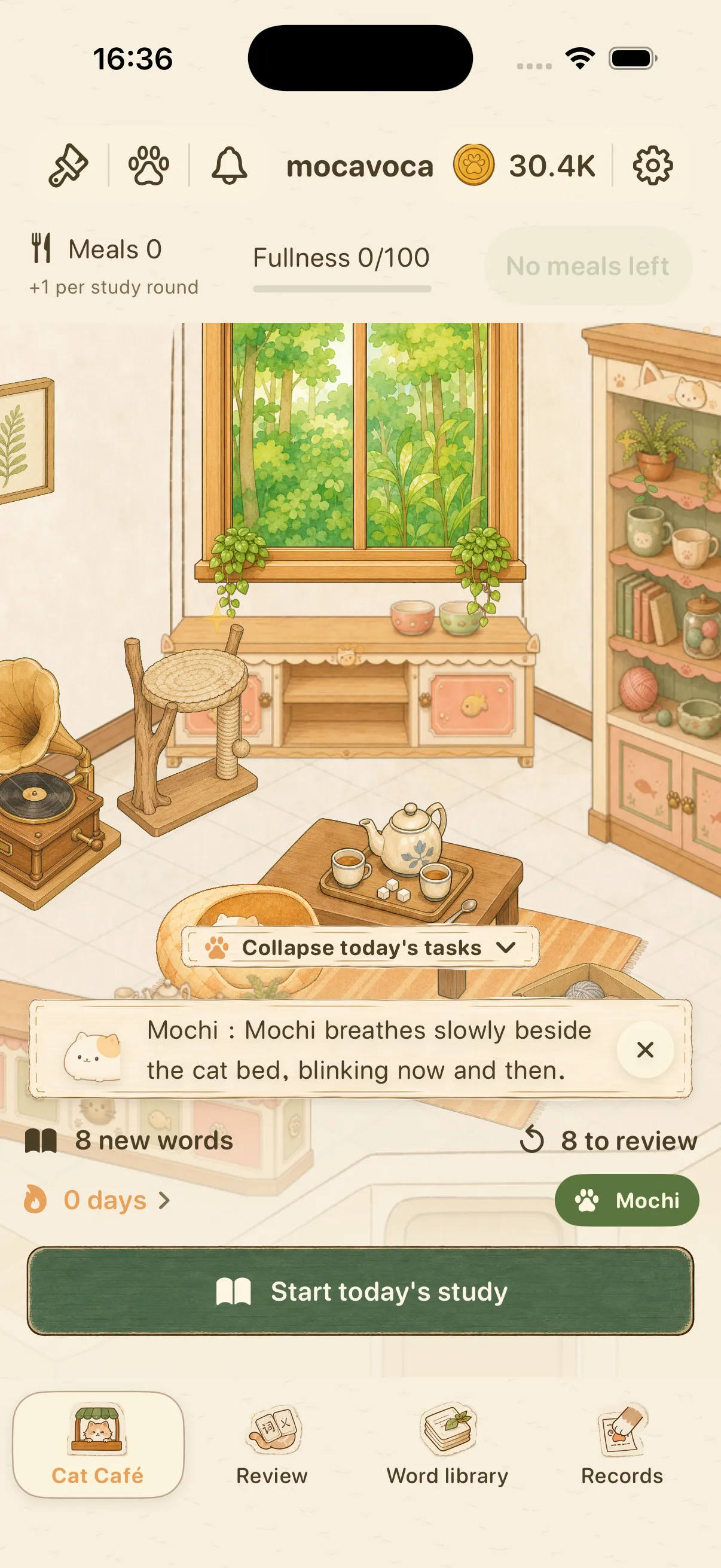 The cat café home screen shows your due reviews, daily new-word target, and the Start studying button right on the counter where Mochi waits.
Step 1: Choose a wordbook for your current goal
Open the wordbook shelf from the home screen or Settings → Current Wordbook to browse 20+ built-in decks compiled from the New General Service List (NGSL / NAWL) and official exam syllabuses:
| Deck Category | Featured Wordbooks | Best For |
|---|---|---|
| Core & Academic English Corpora | NGSL High-Frequency Core (~92% coverage of everyday English text), NAWL Academic Word List | Self-directed learners building a solid reading, listening, and speaking foundation without wasting time on obscure words |
| International Standardized Exams | IELTS Core, TOEFL Core, GRE High-Frequency, TOEIC Business Vocabulary | Test-takers who need accurate listening recognition, reading synonym precision, and exact spelling under time pressure |
| University & National Syllabuses | CET-4, CET-6, Postgraduate Entrance (4,708 words), TEM-4 / TEM-8 |
University students working through an exam syllabus on a fixed timeline |
| Everyday Topics & Japanese | Daily Life, Coffee & Food, Business Communication, JLPT N5 Selected Vocabulary (667 words) |
Learners picking up practical everyday expressions or starting Japanese with kana readings and audio |
Step 2: Independent progress saved per wordbook
Many flashcard apps wipe your daily schedule or jumble review queues when you switch decks. Mocavoca stores an independent StudyDay | WordBook snapshot for every single wordbook:
- Switch decks anytime without losing progress: You can study TOEFL or NGSL on weekdays and switch to Coffee & Food or JLPT N5 Japanese on weekends. Every deck preserves its own Not started, Learning, Mastered, and Mistake counts.
- Pick up right where you left off: Switching back to an earlier wordbook immediately restores your exact place and review queue.
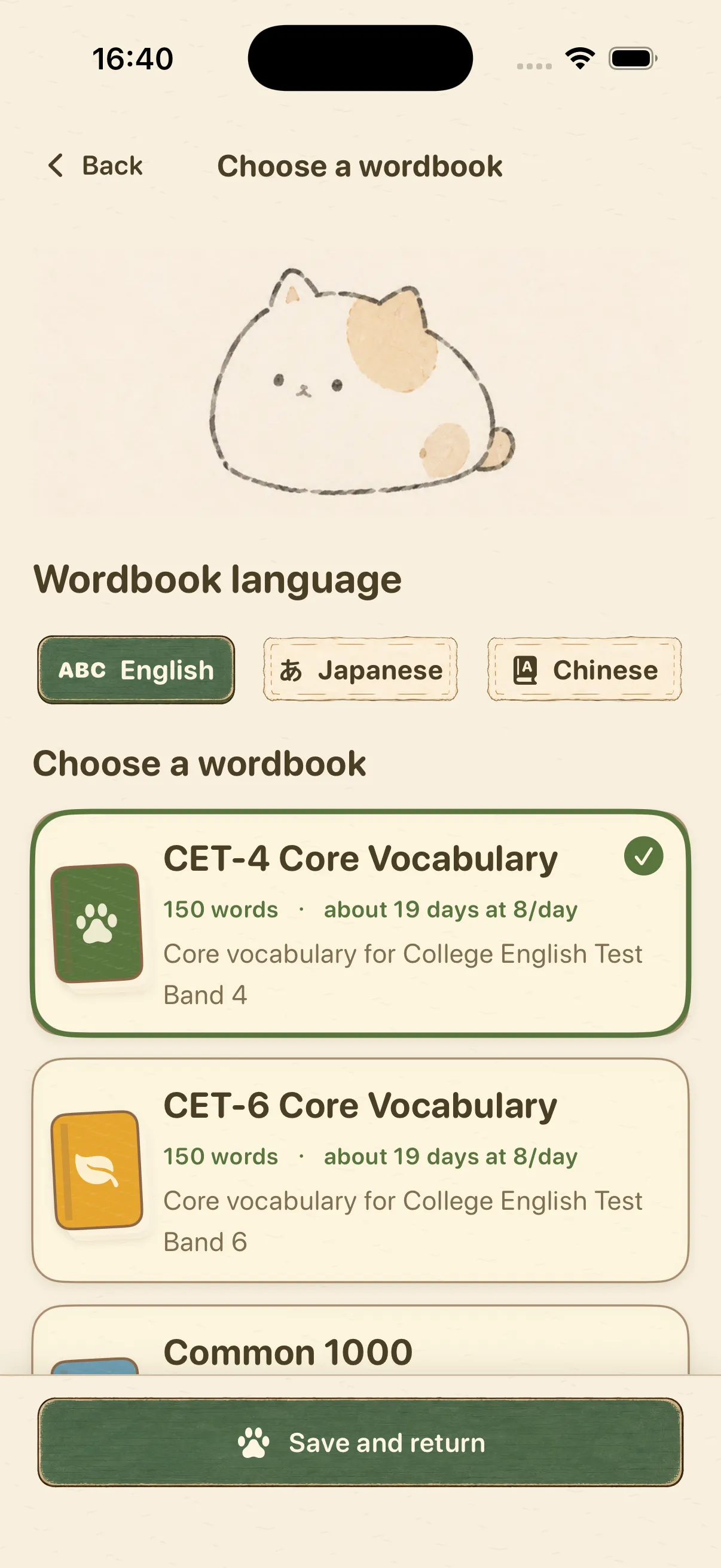 Each wordbook keeps its own progress bar and review history, so switching decks never resets your work.
Step 3: Set a sustainable daily new-word goal
In any spaced repetition system, your daily new-word count determines how many reviews return by Day 10 and beyond. Because words from 1, 3, and 7 days ago come back to meet today’s new words, your steady-state daily review load settles at roughly 2.5× to 3× your daily new-word setting.
You can adjust your pace anytime in Settings → Daily New-Word Goal:
| Daily New Words | Steady-State Daily Reviews (Day 10+) | Estimated Daily Time | Recommended For |
|---|---|---|---|
| 8 new words / day | ~18–24 due reviews | 8–12 minutes | Busy schedules, building a consistent daily habit, or tackling dense academic decks |
| 12 new words / day | ~28–35 due reviews | 12–16 minutes | Most learners preparing for IELTS, TOEFL, TOEIC, or JLPT N5 on a steady schedule |
| 16+ new words / day | ~40–50 due reviews | 18–25 minutes | Dedicated morning/evening study blocks ahead of an upcoming exam date |
For a full breakdown of how long each deck takes at 8 vs. 12 words a day, see How Many Words to Learn a Day? A 15-Minute Spaced Repetition Pace.
Step 4: Your daily study loop
Once your deck and pace are set, your daily routine stays simple:
- Tap Start on the home screen: Today’s Plan serves your due core reviews first, followed by today’s new-word quota.
- Complete 4-word micro-batches: Study each word on a single-screen watercolor card, then verify recall across meaning, audio listening, and spelling (see Word cards, active recall, and spaced repetition).
- Collect coins and cat meals: Check your daily accuracy on the results screen and spend your study coins in the cat café.