
We Built a Gamified Vocabulary App Around Four Cats | Mocavoca
Looking for a calmer Quizlet or Anki alternative on iOS? Step inside Mocavoca’s watercolor cat café—combining spaced repetition flashcards, 3-way active recall, and 20+ wordbooks.
Most of us have installed three or four vocabulary apps on our iPhones, and the story almost always ends around Day 10.
You start on a Monday full of ambition, set the daily goal to fifty or a hundred words, and keep a streak alive for nine straight days. Then a late flight, an exam week, or a bad cold makes you miss a single evening. When you open the app the next morning, two things hit you at once: your ten-day streak is back at zero, and your review queue has ballooned into three hundred overdue cards in bright red text. Nobody wants to dig out from under three hundred flashcards before breakfast. You close the app, and a week later you delete it.
Before we wrote a line of code for Mocavoca, we had lived through that exact cycle across every category of study software. On one side are passive flashcard decks where flipping cards feels easy in the moment, or DIY spaced repetition tools like Anki where five missed days trigger an overwhelming review avalanche. On the other side are punitive streak games that push paid streak freezes, or cute pet timers that have charming animations but no serious exam or academic word lists underneath.
We built Mocavoca for iPhone and iPad to bridge that gap—a gamified vocabulary app and calm Quizlet or Anki alternative where a hand-painted watercolor cat café meets spaced repetition flashcards, three-way active recall, and over twenty formal wordbooks.
There is a word in our core wordbook that guided the whole design: sanctuary.
A quiet cat café can be a small sanctuary from noisy timelines.
Why the Furniture Shop Has No Cash Register
When you open Mocavoca, the home screen is a warm wooden cat café. New learners who poke around the furniture shop almost always ask the same question: “Where is the button to buy extra coins with real money?”
There isn’t one, and there never will be. When you gamify learning, the fastest way to ruin a study habit is to let cash microtransactions replace actual effort. Every wooden table, every vintage armchair, every potted plant, and every bowl of cat food in Mocavoca has to be bought with coins you earned by remembering words.
Every piece of furniture in the room is earned through earnest study.
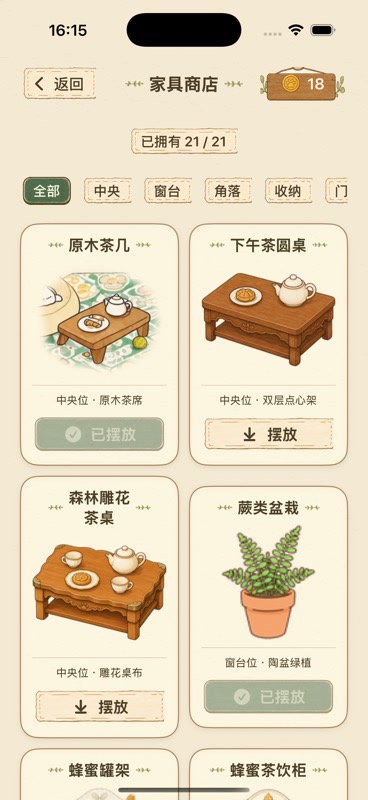
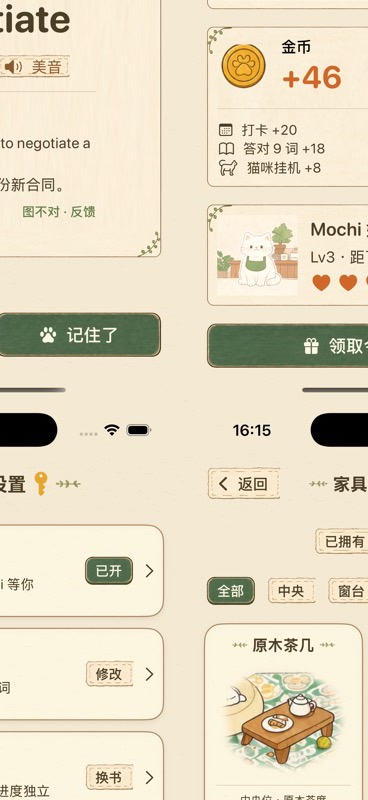
For those armchairs and lamps to mean anything, the café’s ledger has to be strict about how coins are earned. If tapping random options handed out coins, the room would turn into an idle clicker game by Friday. So Mocavoca only pays out 2 study coins when you pass a word’s first core check of the day on your own—without peeking at the answer and without using a letter hint. Guessing after a hint or repeating the same word five times in one afternoon won’t mint extra coins. Once you finish a full daily round (or up to two optional extra rounds), the kitchen automatically sets aside 1 bowl of cat food.
At the same time, the ledger never punishes you for having a life outside your phone. Once you place a rug or a bookshelf in the café, it stays yours for good. If finals week or a family trip keeps you away for five days, you won’t come back to confiscated furniture or a wiped-out coin balance. The warm floor lamp is still on, and your room is waiting right where you left it.
Four Cats, and Three Very Different Bowls of Food
On your first day in the café, a calico cat named Mochi is waiting by the counter. Mochi is curious and shamelessly food-motivated—whenever a new cardboard furniture box arrives or a ceramic bowl clinks in the kitchen, Mochi is first on the scene. As you keep studying and move through your wordbooks, three more regulars settle into the room: Latte, an orange-and-white cat who spends every sunny afternoon curled up by the window; Sora, a quiet blue-and-white observer who perches on the highest wooden bookshelf while you work through dense academic reading; and Luna, a bright-eyed black cat who keeps late-night learners company under the desk lamp.
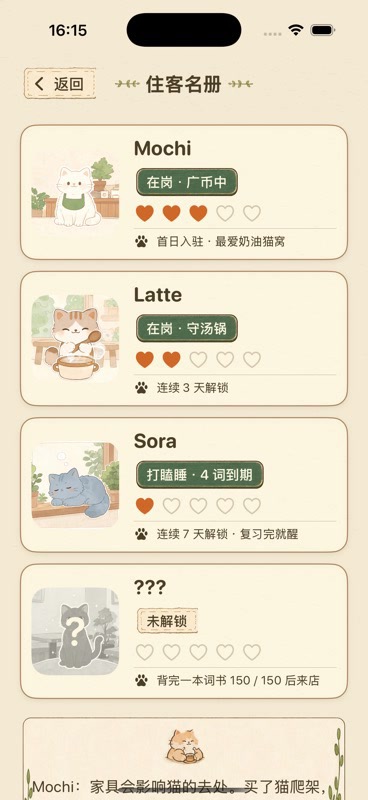
Because it takes a full round of real study to earn a bowl of cat food, feeding time shouldn’t be a flat popup banner. We hand-painted different 24fps watercolor animations depending on how many meals you have fed Mochi that day.
On the first meal of the day, Mochi finishes eating, looks up with crescent eyes, and hugs both cheeks with its front paws in a wide grin:
If you come back for an extra study round and serve a second bowl, Mochi trots right up to the glass to nuzzle you. By the third meal of the day, Mochi drops all reserve, flops onto its back to show a fluffy belly, stretches out full-length, and lets out a quiet purr:
Active Recall Flashcards Underneath the Watercolor
The biggest trap for any cute study app or cat cafe game is making the room charming while letting the vocabulary slip right through your fingers.
Plenty of apps let you swipe through fifty flashcards in ten minutes because all they ask you to do is tap a familiar multiple-choice option or flip a two-sided card and tell yourself, “Yeah, I knew that.” Everything looks familiar while the answer is staring back at you, and then vanishes the moment you sit down to read an article or write an essay. A word only sticks when your brain has to reach for it without a net.
That is why Mocavoca separates learning a word from testing it.
When you first meet a word, the custom watercolor scene, phonetic pronunciation, part-of-speech definition, and complete example sentence all sit together on a single screen (we wrote more about how visual scenes and sentences work together in Learn Words in Sentences). You don’t have to flip back and forth between front and back just to see how the word behaves in context.
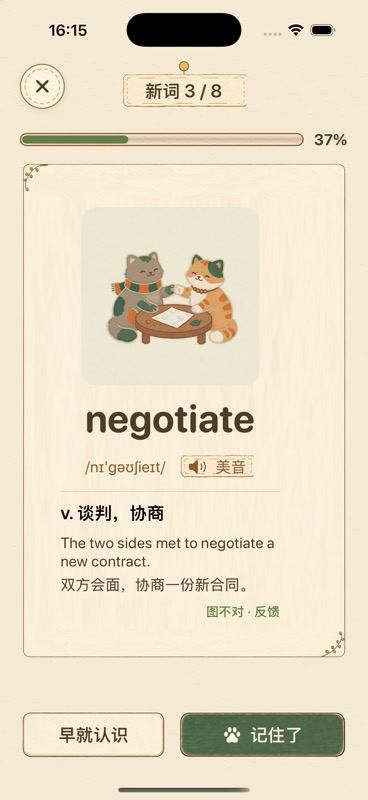
Then comes the checkup. Mocavoca breaks your daily words into small groups of up to four words and tests every card across three independent active recall checks: first by reading the English word and recalling its meaning, next by hiding the written word completely so you have to recognize it by ear alone, and finally by typing the full spelling from scratch.
If you miss a question or tap a hint, the app refuses to hand you the exact same question three seconds later—because answering from a two-second visual echo isn’t remembering. Instead, it tucks the missed card back into the deck, asks you at least two questions from other words first, and only brings the missed word back once your short-term echo has faded, before advancing it along a 1, 3, 7, 14, and 30-day spaced repetition schedule (see How to Remember Vocabulary You Keep Forgetting).
Over Twenty Formal Wordbooks on the Café Shelf
A cozy room only helps if the bookshelf carries the exact vocabulary you need for class, work, or exams. Instead of relying on unverified user decks, Mocavoca curates over twenty structured wordbooks from open linguistic corpora—pairing every headword with verified watercolor art, audio, and natural example sentences:
Whether you are building everyday fluency with the New General Service List (NGSL, 2,748 words) and NGSL Spoken (668 words), preparing for university reading with the New Academic Word List (NAWL, 953 words), IELTS (5,031 words), TOEFL (6,970 words), GRE Selected (4,079 words), TOEIC (1,249 words), or Business English (BSL, 1,742 words), or exploring our JLPT N5 Beginner Japanese selection, every wordbook keeps its own independent daily snapshot. You can study academic English on your morning train and switch to Café & Food or starter Japanese after dinner without ever tangling your review queues (see How Many Words to Learn a Day for the full 14-wordbook timeline).
No app—ours included—can memorize a language for you without effort. A watercolor cat café won’t turn four thousand academic words into an overnight shortcut. What it can do is keep the room quiet, keep the ledger honest, and make sure that when you put in fifteen minutes of real focus, someone furry is waiting by the bowl to celebrate with you.
Plan Your Daily Vocabulary Pace · Practice Beginner Japanese · Download & Subscription Details · Open in the App Store

About the author
Mocavoca team — The product and curriculum team behind Mocavoca, writing spaced repetition wordbook guides, active recall vocabulary exercises, and iPhone/iPad app help.